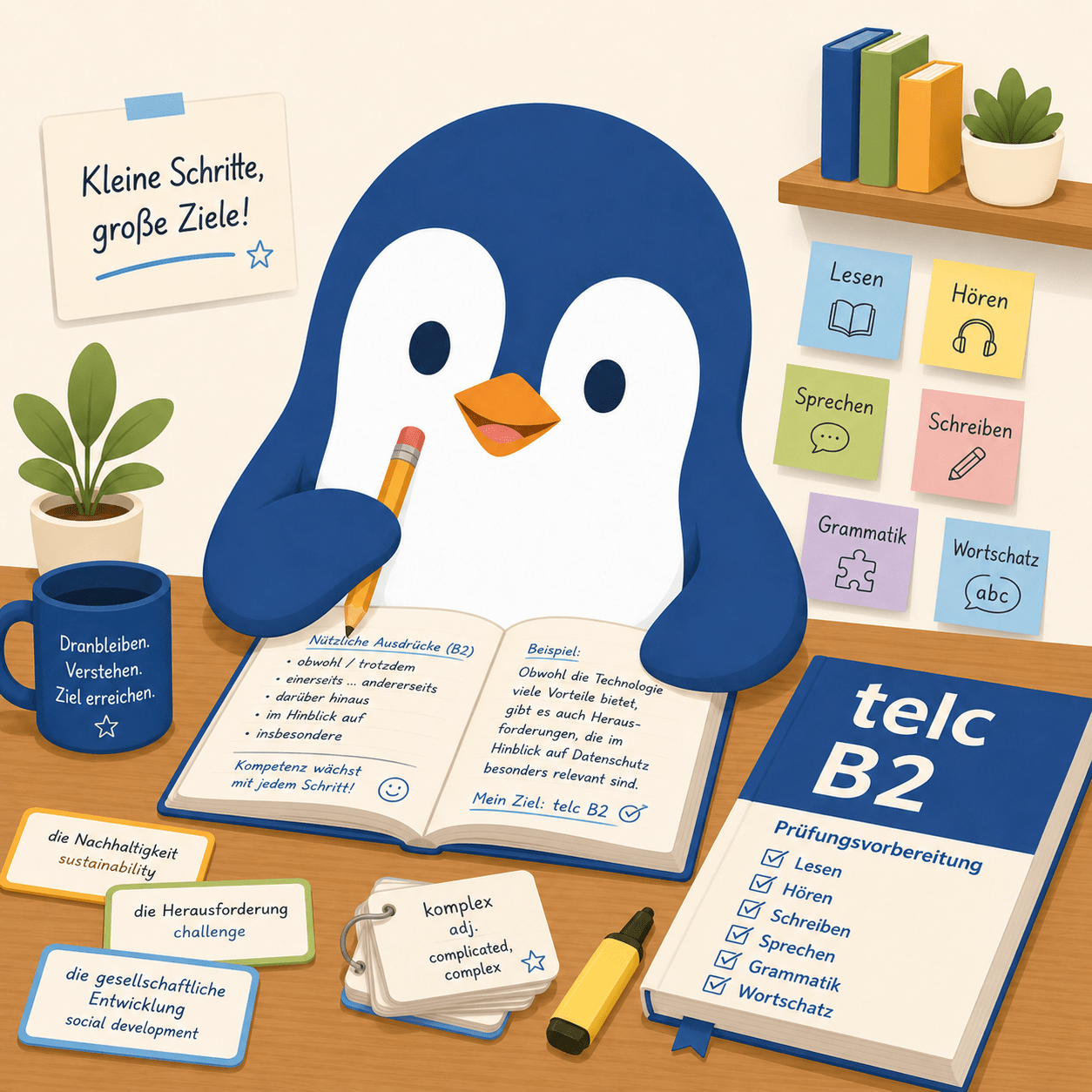
Many verbs require a fixed preposition, and you have to learn it along with them. In the language elements they are a common topic. Here come the most important combinations for B2.
Verbs with fixed prepositions
How ready are you really?
Your Ready-Score shows you in a mock exam where you stand today. Free, no risk.
Always learn verb, preposition and case as a unit:
- warten auf (+ accusative): “Ich warte auf den Bus.”
- sich freuen auf (+ accusative): for something in the future.
- denken an (+ accusative): “Ich denke an dich.”
- sich interessieren für (+ accusative).
- teilnehmen an (+ dative).
- gehören zu (+ dative).
- sich kümmern um (+ accusative).
- abhängen von (+ dative).
Which cases lie behind this is also clarified in prepositions with accusative and dative, and what the part is about is shown in telc B2 language elements. Another common gap topic is the modal verbs.
How to learn them
Do not learn the verbs individually but as a fixed combination with preposition and case. Flashcards with an example sentence help, because you remember the whole sentence.
In the telc exam
In the gaps it is often exactly the preposition that is missing. How to proceed strategically is in solving language elements strategically, and where the part sits in the procedure is shown by the page on the exam sections.
The bottom line
Verbs with prepositions are pure learning, but rewarding: whoever knows the most common combinations confidently solves the matching gaps in their sleep.